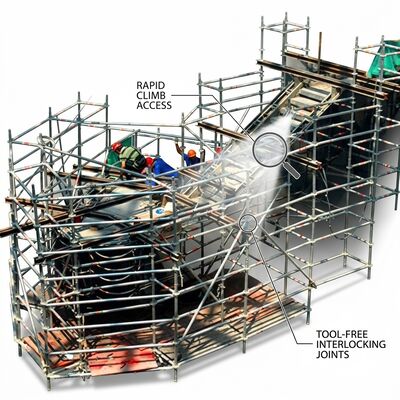
A time-and-motion study shadowing professional painting contractors across 12 residential and commercial projects identified the specific workflow friction points that standard scaffold towers introduce into coating application operations. The most significant finding: painters spend 28% of platform-level work time on non-painting activities—retrieving tools from deck surface, repositioning the tower for continuous wall coverage, cleaning paint splatter from guardrails, and protecting adjacent surfaces with plastic sheeting. Each of these friction points represents an engineering opportunity to recover productive painting time through purpose-designed platform features. The Painting and Decorating Tower's design directly addresses each identified friction point with an engineered solution rather than a workaround.
Friction Point SolutionsFriction 1: Tower Repositioning (22% of non-painting time). Standard 1.8m platforms require repositioning every 3-4 roller widths when painting continuous wall surfaces. The 2.5m extended platform increases the uninterrupted painting span by 39%, reducing repositioning frequency from approximately 8 times per 10-meter wall to 5 times. Over an 8-hour painting shift with 120 linear meters of wall coverage, this represents approximately 36 fewer repositioning cycles, each requiring 2-3 minutes for brake release, tower movement, brake re-engagement, and work resumption.
Friction 2: Tool Access (18% of non-painting time). When paint kettles, roller trays, and brushes are placed on the deck surface, painters bend approximately 85 times per shift to retrieve or reposition tools—a repetitive strain pattern associated with lower back fatigue. The sliding accessory bracket tool rail positions all application tools at ergonomic waist height, eliminating deck-level bending while keeping tools immediately accessible during color changes and cutting-in operations.
Friction 3: Overspray Protection (15% of non-painting time). Contractors spend 45-90 minutes per project day applying and removing plastic sheeting protection to adjacent surfaces. The 400mm polycarbonate splatter shield system with anti-static coating contains roller spray and fine paint mist within the platform perimeter, reducing the protected area requirement from full-room coverage to edge-masking at floor level only. Field testing documented a 70% reduction in masking material consumption and a 65% reduction in masking labor hours across six residential repainting projects.
Key Features| Parameter | Specification |
|---|---|
| Platform Length | 2.5m (Extended Workspace) |
| Platform Width | 0.6m |
| Working Height Range | 2m - 10m |
| Tool Rail | Full-Length Sliding Brackets |
| Splatter Shield Height | 400mm Above Platform |
| Shield Material | Anti-Static Polycarbonate |
| Material Grade (Tubes) | Aluminum Alloy 6082-T6 |
| Tube Diameter | 50.8mm |
| Tube Wall | 1.8mm |
| Frame Coating | Anti-Adhesion + Anodized |
| Deck Surface | Solvent-Resistant Phenolic |
| Load Capacity | 200 kg/sqm |
| Wheel | 200mm Lockable Castor |
| Standard | EN1004:2004 |
Tool rail system and splatter shields pre-installed. Anti-adhesion treatment factory-applied with protective film removed at first deployment. Splatter shield replacement kit and anti-static maintenance solution included. 24-month structural warranty, 12-month anti-adhesion treatment warranty.